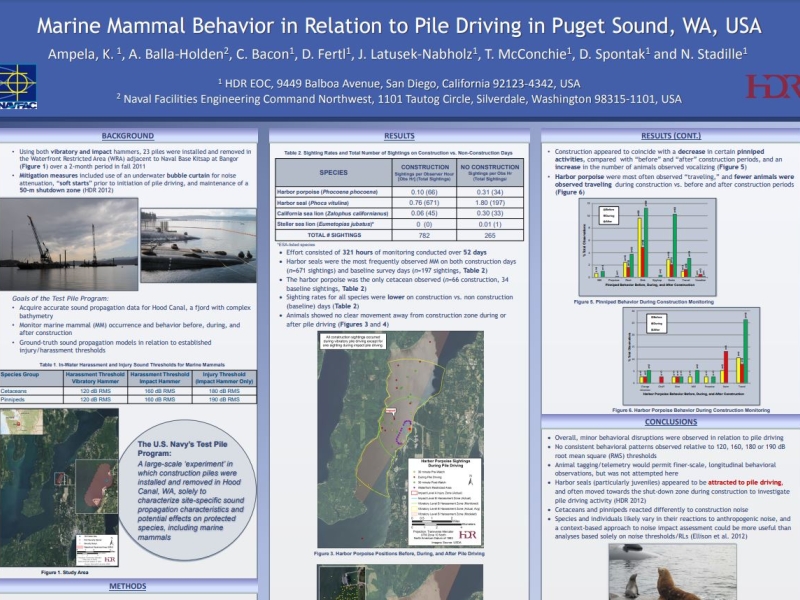

Mixed-species associations seen in the Southern California Bight during aerial surveys 2008-2012.
Southern California Marine Mammal Workshop 2013 .
More details
Collapse details
Date Published:
Filesize:
- February 1, 2013
Fifteen aerial surveys (72,647 km) occurred during 2008-2012 to monitor occurrence, abundance, and behavior of marine mammals in the Southern California Bight (SCB) on behalf of the U.S. Navy. Thirty-six (2%) of 2,151 total sightings of at least 11 species were mixed-species associations (i.e., at least two different species swimming together/interacting). Little is known about these associations. Risso’s dolphins were most frequently associated with another marine mammal species (19 [7%] of 238 total Risso’s sightings) as follows: with sperm whales (1x), California sea lions (CaSL) (3x), and bottlenose (7x), northern right whale (NRWD) (4x), long-beaked common (1x), unidentified (1x), and common dolphin sp. (2x). Up to 3 species occurred together on 3 different occasions: (1) sperm whales/Risso’s/NRW dolphins, (2) Risso’s/unidentified dolphins/CaSL, and (3) Pacific white-sided/common dolphins with CaSL. The most unusual mixed species sighting was 24 sperm whales (including 4 calves) with 11 Risso’s and ~50 NRW dolphins: Risso’s repeatedly charged adult sperm whales’ heads who responded by dropping their lower jaw, perhaps related to kleptoparasitism. Potential reasons for mixed-species associations include increased protection from predators via dilution, increased prey detection/consumption, and “play” (i.e., fin whale calf touching NRWD). Data include interactions not previously documented in the SCB among these socially complex animal groups.
- 2,082.37 KB
Mixed-species associations of marine mammals in the Southern California Bight, with emphasis on Risso’s dolphins (Grampus griseus).
Aquatic Mammals. 2017.
43:177-184
More details
Collapse details
Date Published:
Publication:Ocean:Region:Species:Methods:
- January 1, 2017
This study investigates mixed-species associations among marine mammals in the Southern California Bight, focusing specifically on Risso's dolphins (Grampus griseus). Over a six-year period, aerial surveys were conducted to record the frequency and nature of these associations, revealing that Risso's dolphins were the most commonly observed species in mixed interactions. The results indicate a significant decline in the proportion of Risso's dolphins involved in such associations compared to historical records, possibly due to an increase in their relative abundance. The findings underline the importance of monitoring mixed-species associations to understand marine mammal dynamics and ecological interactions.
More details
Collapse details
Date Published:
Filesize:
- July 17, 2015
The purpose of this report is to summarize information obtained through the remote deployment of Low-Impact Minimally-Percutaneous External-electronics Transmitter (LIMPET) satellite tags on odontocete cetaceans off Cape Hatteras, North Carolina, in 2014. This study was undertaken to provide information on spatial use and diving behavior of a number of species of odontocetes, with particular emphasis on Cuvier’s beaked whales (Ziphius cavirostris) and short-finned pilot whales (Globicephala macrorhynchus).
- 2,545.14 KB
More details
Collapse details
Date Published:
Filesize:
- March 1, 2018
This work builds upon and complements longer-term studies of movements and site fidelity of both Cuvier’s beaked whales (Ziphius cavirostris) and short-finned pilot whales (Globicephala macrorhynchus) off the North Carolina coast using photo-identification (photo-ID)
- 4,344.84 KB
More details
Collapse details
Date Published:
Filesize:
- June 1, 2019
This work builds upon and complements longer-term studies of movements and site fidelity of both Cuvier’s beaked whales (Ziphius cavirostris) and short-finned pilot whales (Globicephala macrorhynchus) off the North Carolina coast using photo-identification (photo-ID)
- 2,642.94 KB
More details
Collapse details
Date Published:
Filesize:
- December 1, 2020
The overall goal of this study was to include the 2018 survey data in the previous 1991–2014 modeling dataset in order to improve SMDs for the CCE study area. Specific objectives included: Generating multi-year average density surfaces for the Navy and others to use in their long-term (2–7 year) environmental planning efforts; and Providing updated abundance and “minimum population size (Nmin)” estimates as defined in the Guidelines for Assessing Marine Mammal Stocks (National Oceanic and Atmospheric Administration 2016).
- 5,465.27 KB
Habitat-Based Density Models for Three Cetacean Species off Southern California Illustrate Pronounced Seasonal Differences.
Frontiers in Marine Science. 2017.
4:121. doi: 10.3389/fmars.2017.00121.
More details
Collapse details
Date Published:
Publication:Ocean:Region:Species:Methods:
- May 10, 2017
The objectives of our study were two-fold: (1) develop spatially-explicit density estimates for winter/spring to support management applications, and (2) compare model-predicted density and distribution patterns to previously developed summer/fall model results in the context of species ecology. We used a well-established Generalized Additive Modeling framework to develop cetacean SDMs based on 20 California Cooperative Oceanic Fisheries Investigations (CalCOFI) shipboard surveys conducted during winter and spring between 2005 and 2015.
Evaluating Seasonal vs. Spatial Extrapolation for Cetacean Distribution Models in the California Current.
Marine Mammal Science. 2025.
41(4):e70030
More details
Collapse details
Date Published:
Publication:Ocean:Region:Species:Methods:
- June 13, 2025
In this study, winter and spring density estimates for the entire CCE study area were made from SWFSC summer and fall model predictions (temporal extrapolation) and CalCOFI winter and spring model predictions (spatial extrapolation) for short-beaked common dolphin ( Delphinus delphis delphis ), Pacific white-sided dolphin ( Lagenorhynchus obliquidens ), Dall's porpoise ( Phocoenoides dalli ), and fin whale ( Balaenoptera physalus ).
Longitudinal comparisons of digital photography of marine mammals from aircraft and shore.
Southern California Marine Mammal Workshop 2014 .
More details
Collapse details
Date Published:
Filesize:
- January 31, 2014
Rapid progress and affordability of photographic technology with increasing improvements in image resolution have facilitated advancements in efficiency and alternative approaches in data collection for marine mamma ls. We report these recent improvements by comparing marine mammal photographs taken during 2008-2013 aerial surveys of 16 marine mammal species in the Southern California Bight, shore-based studies of bottlenose dolphins (Tursiops truncatus) in Galveston Bay, Texas (2011 - 2013), and gray whales (Eschrichtius robustus) off Sakhalin Island, Russia (2004 -2010).
- 1,436.95 KB
Seasonal changes in physical oceanography modulate cetacean predator-prey dynamics in the San Diego Trough.
Marine Ecology Progress. 2025.
762:111–133
More details
Collapse details
Date Published:
Publication:Ocean:Region:Species:Methods:
- June 12, 2025
In marine ecosystems, cetaceans are large mobile predators that depend on maximizing foraging efficiency. Their presence within a habitat can therefore be strongly related to the modulation of local prey by oceanographic conditions. Understanding how cetaceans are impacted by prey responses to the physical environment is challenging due to the difficulty of collecting presence data of cetaceans and their prey over long, comparable time periods. We used passive and active acoustic recordings collected from moorings within the San Diego Trough, along with physical oceanographic sampling (i.e. in situ, satellite-derived, and ocean general circulation model measurements), to elucidate relationships between cetaceans, their prey, and the physical environment. Our results show that the predator-prey dynamics of some cetaceans within the San Diego Trough are influenced by seasonal changes in the physical oceanographic conditions and processes that shape their prey resources. Specifically, common dolphin Delphinus delphis foraging activity increased during conditions associated with increased presence of diel vertically migrating fish prey. Blue whale Balaenoptera musculus foraging-associated acoustic activity increased during periods with increased presence of mid-water crustacean zooplankton and was replaced with breeding-associated acoustic activity during conditions associated with the waning of mid-water crustacean zooplankton. Fin whale B. physalus foraging-associated calling activity was more complex to model, most likely because these animals have a generalist diet and occupy this area year-round. Our results highlight environmental conditions and features relevant to cetaceans inhabiting this region and may aid in developing better spatially explicit management actions.
More details
Collapse details
Date Published:
Filesize:
- September 15, 2010
This report summarizes small boat based research conducted on cetaceans off southern California by the Scripps Institution of Oceanography (SIO) in collaboration with Southwest Fisheries Science Center (SWFSC) from August 2009 – July 2010. The primary objectives of this research were to use sighting, photo-identification, biopsy and acoustical sampling techniques to assess the occurrence, distribution and population structure of small cetaceans in a region that is subject to frequent naval exercises; this information is needed to evaluate possible effects from Mid Frequency Active Sonar (MFAS) trials and ultimately for the development of appropriate management protocols.
- 2,641.69 KB
More details
Collapse details
Date Published:
Filesize:
- October 24, 2014
The present study provides new and current estimates of cetacean density for the six most commonly encountered cetacean species off southern California based on sighting data collected during 37 quarterly CalCOFI cruises from 2004 to 2013. The current study resulted from a high survey repetition rate that allowed for the examination of inter-annual and seasonal trends in density as well as temporal and spatial patterns of distribution for six common cetacean species off southern California: blue whales, fin whales, humpback whales, short-beaked common dolphins, Pacific white-sided dolphins, and Dall’s porpoise.
- 4,140.75 KB
More details
Collapse details
Date Published:
Filesize:
- December 1, 2012
Spatial and temporal distribution patterns, density and abundance of cetaceans in the southern California Bight were assessed through visual and acoustic surveys during five California Cooperative Oceanic Fisheries Investigations (CalCOFI) cruises from August 2011 – July 2012. Visual monitoring incorporated standard line-transect protocol during all daylight transits while acoustic monitoring employed a towed hydrophone array during transits and sonobuoys at oceanographic sampling stations.
- 4,929.65 KB
More details
Collapse details
Date Published:
Filesize:
- February 1, 2014
Cetacean distribution, density and abundance in the Southern California Bight were assessed through visual and acoustic surveys during five California Cooperative Oceanic Fisheries Investigations (CalCOFI) cruises from August 2012-November 2013. Visual monitoring incorporated standard line-transect protocol during all daylight transits while acoustic monitoring employed a towed hydrophone array during transits and sonobuoys at oceanographic sampling stations. Visual effort included 584 observation hours covering 10,900 kilometers yielding 565 sightings of 15 identified cetacean species.
- 4,333.04 KB
Inter-annual and seasonal trends in cetacean distribution, density and abundance off southern California.
Deep-Sea Research. 2015.
112: 143-157
More details
Collapse details
Date Published:
Publication:Ocean:Region:Species:Methods:
- January 1, 2015
Trends in cetacean density and distribution off southern California were assessed through visual line-transect surveys during thirty-seven California Cooperative Oceanic Fisheries Investigations (CalCOFI) cruises from July 2004–November 2013. From sightings of the six most commonly encountered cetacean species, seasonal, annual and overall density estimates were calculated. Blue whales (Balaenoptera musculus), fin whales (Balaenoptera physalus) and humpback whales (Megaptera novaeangliae) were the most frequently sighted baleen whales with overall densities of 0.91/1000km2 (CV=0.27), 2.73/1000km2 (CV=0.19), and 1.17/1000km2 (CV=0.21) respectively. Species specific density estimates, stratified by cruise, were analyzed using a generalized additive model to estimate long-term trends and correct for seasonal imbalances. Variances were estimated using a non-parametric bootstrap with one day of effort as the sampling unit. Blue whales were primarily observed during summer and fall while fin and humpback whales were observed year-round with peaks in density during summer and spring respectively. Short-beaked common dolphins (Delphinus delphis), Pacific white-sided dolphins (Lagenorhynchus obliquidens) and Dall’s porpoise (Phocoenoidesdalli) were the most frequently encountered small cetaceans with overall densities of 705.83/1000km2 (CV=0.22), 51.98/1000km2 (CV=0.27), and 21.37/1000km2 (CV=0.19) respectively. Seasonally, short-beaked common dolphins were most abundant in winter whereas Pacific white-sided dolphins and Dall’s porpoise were most abundant during spring. There were no significant long-term changes in blue whale, fin whale, humpback whale, short-beaked common dolphin or Dall’s porpoise densities while Pacific white-sided dolphins exhibited a significant decrease in density across the ten-year study. The results from this study were fundamentally consistent with earlier studies, but provide greater temporal and seasonal resolution. Keywords: Cetaceans; Line transect; Density; Abundance; Distribution; Trends; Southern California; CalCOFI
Common dolphin whistle responses to experimental mid-frequency sonar.
PLOS One. 2024.
19(4):e0302035
More details
Collapse details
Date Published:
Publication:Ocean:Region:Species:Methods:
- April 26, 2024
Using a network of drifting acoustic buoys in controlled exposure experiments, we investigated the effects of mid-frequency (3–4 kHz) active sonar (MFAS) on whistle production in short-beaked (Delphinus delphis delphis) and long-beaked common dolphins (Delphinus delphis bairdii) in southern California. Given the complexity of acoustic behavior exhibited by these group-living animals, we conducted our response analysis over varying temporal windows (10 min– 5 s) to describe both longer-term and instantaneous changes in sound production. We found that common dolphins exhibited acute and pronounced changes in whistle rate in the 5 s following exposure to simulated Navy MFAS.
More details
Collapse details
Date Published:
Filesize:
- November 1, 2019
This project is intended to provide baseline information on the species composition, density, distribution, and basic behavior of marine mammals and sea turtles present within the United States (U.S.) Navy’s Virginia Capes (VACAPES) Operating Area (OPAREA). This study is part of a larger, multi-institutional, marine mammal and sea turtle monitoring program of U.S. Navy range complexes along the U.S. Atlantic Coast and Gulf of Mexico supporting Atlantic Fleet Training and Testing (AFTT)
- 4,083.79 KB
More details
Collapse details
Date Published:
Filesize:
- August 1, 2017
This report forms part of a multi-institutional monitoring project intended to provide information on the species composition, population identity, density, and baseline behavior of marine mammals and sea turtles present in United States (U.S.) Navy range complexes along the U.S. Atlantic Coast.
- 11,346.94 KB
More details
Collapse details
Date Published:
Filesize:
- September 1, 2015
This report forms part of a multi-institutional monitoring project intended to provide information on the species composition, population identity, density, and baseline behavior of marine mammals and sea turtles present in United States (U.S.) Navy range complexes along the U.S. Atlantic Coast.
- 26,430.91 KB
More details
Collapse details
Date Published:
Filesize:
- April 1, 2017
Cetacean distribution, density and abundance in the Southern California Bight were assessed through visual and acoustic surveys during eighteen California Cooperative Oceanic Fisheries Investigations (CalCOFI) cruises from February 2012-April 2016. Visual monitoring incorporated standard line-transect protocol during all daylight transits while acoustic monitoring employed a towed hydrophone array during transits and sonobuoys deployed at oceanographic sampling stations. Visual effort included 2,031 observation hours covering 31,807 kilometers. A total of 1,914 sightings were made, which included 18 different cetacean species. Acoustic effort included 1m027 sonobuoy deployments and 478 towed array deployments.
- 6,733.49 KB
More details
Collapse details
Date Published:
Filesize:
- January 1, 2011
Navy Research Funded Year Three Project Reports
- 5,699.30 KB
More details
Collapse details
Date Published:
Filesize:
- June 17, 2012
This document contains amplifying technical data and information for the United States Department of the Navy’s Southern California Range Complex Comprehensive Monitoring Report.
- 51,916.96 KB
More details
Collapse details
Date Published:
Filesize:
- September 7, 2024
In the Pacific, the Marine Mammal Monitoring on Navy Ranges (M3R) program maintains systems that continuously run algorithms to detect, classify and localize marine mammals year-round on the U.S. Navy’s deep-water Southern California Antisubmarine Warfare Range (SOAR) in Southern California and the Pacific Missile Range Facility (PMRF) off Kaua‘i, Hawai‘i. Long-term archive data collected on these ranges allow for numerous types of studies on species inhabiting the ranges, including the monitoring of abundance, behavioral responses to naval activities, and habitat usage. They also provide the opportunity to study ambient sound levels and soundscapes.
- 8,141.88 KB
More details
Collapse details
Date Published:
Filesize:
- January 24, 2013
Documenting year-round diversity and distribution of marine mammals off Southern California is important for assessment of effects of potentially harmful anthropogenic activities. Although the waters off Southern California have been surveyed extensively for marine mammals over the past 18 years, such surveys have been periodic and were conducted primarily from summer to fall, thereby missing potential seasonal shifts. We examined seasonal abundance and population density of cetaceans off Southern California from 16 shipboard line-transect surveys conducted quarterly during 2004–08. The study area consisted of 238,494 km² of coastal, shelf, and pelagic oceanic habitat from near-shore waters to 700 km offshore.
- 2,712.72 KB
More details
Collapse details
Date Published:
Filesize:
- June 1, 2022
The United States (U.S.) Navy routinely conducts training and testing activities in the Virginia Capes (VACAPES) Operating Area (OPAREA) off the mid-Atlantic and Southeast U.S. The region encompassing the deeper waters of the continental shelf, shelf break, and continental slope has been recognized as an important habitat for multiple species of cetaceans. Kenney and Winn (1986) showed that the shelf edge from Cape Hatteras to Georges Bank was the second most intensively used cetacean habitat off the northeastern U.S. based on 3 years of surveys conducted by the Cetacean and Turtle Assessment Program (CETAP 1982). This progress report includes all offshore monitoring activities conducted in 2021. The goals of this effort focus on addressing fundamental information gaps related to marine mammal occurrence, exposure, and response as identified by the U.S. Navy’s Integrated Comprehensive Monitoring Program (DoN 2010) and recommendations provided by a Scientific Advisory Group review (DoN 2011).
- 4,758.82 KB
More details
Collapse details
Date Published:
Filesize:
- October 1, 2016
A combination of visual line-transect survey, photo-identification (photo-ID), and automated acoustic monitoring methods was used to gather important baseline information on the occurrence, distribution, and density of marine mammals near Naval Station Norfolk (NSN) and adjacent areas. The study area was designed to cover areas where United States Navy activity is substantial, including Chesapeake Bay waters near NSN and Joint Expeditionary Base Little Creek-Fort Story, as well as a Mine Exercise (MINEX) Area (W-50) in the Atlantic Ocean off the coast of Virginia Beach, Virginia
- 14,259.08 KB
More details
Collapse details
Date Published:
Filesize:
- August 7, 2015
A combination of visual line-transect survey, photo-identification (photo-ID), and automated acoustic monitoring methods is being used to gather important baseline information on the occurrence, distribution, and density of marine mammals near Naval Station Norfolk and adjacent areas. The study area was chosen to cover areas where United States (U.S.) Navy activity is substantial, including Chesapeake Bay waters near Naval Station Norfolk and Joint Expeditionary Base Little Creek-Fort Story, as well as a Mine Exercise (MINEX) Area (W-50) in the Atlantic off the coast of Virginia Beach, Virginia. Forty-seven line-transect surveys were completed in two zones (INSHORE and MINEX) between August 2012 and December 2014, with 5,106 kilometers (km) and 276.5 hours completed on-effort.
- 20,191.62 KB
More details
Collapse details
Date Published:
Filesize:
- May 1, 2018
Taking into consideration the multiple intermediate scientific objectives in the U.S. Navy’s Strategic Planning Process (DoN 2013b), the goals of this study are to assist the U.S. Navy and regulatory agencies with environmental planning and compliance by addressing the following questions: Which cetacean species occur over the outer continental shelf to the east of NSN, and how does occurrence fluctuate seasonally? What are the baseline behaviors and ecological relationships of offshore cetaceans within the study area? Do individual cetaceans exhibit site fidelity within specific regions of the study area over periods of weeks, months, or years? What is the seasonal extent of cetacean movements within and around U.S. Navy VACAPES training range boxes? Do cetaceans spend significant time within or primarily
- 6,780.82 KB
More details
Collapse details
Date Published:
Filesize:
- May 1, 2025
Taking into consideration the multiple intermediate scientific objectives in the U.S. Navy’s Strategic Planning Process (DoN 2013), the goals of this study are to assist the U.S. Navy and regulatory agencies with environmental planning and compliance
- 7,272.43 KB
More details
Collapse details
Date Published:
Filesize:
- July 1, 2019
Taking into consideration the multiple intermediate scientific objectives in the U.S. Navy’s Strategic Planning Process (DoN 2013b), the goals of this study are to assist the U.S. Navy and regulatory agencies with environmental planning and compliance by addressing the following questions: Which cetacean species occur over the outer continental shelf to the east of NSN, and how does occurrence fluctuate seasonally? What are the baseline behaviors and ecological relationships of offshore cetaceans within the study area? Do individual cetaceans exhibit site fidelity within specific regions of the study area over periods of weeks, months, or years? What is the seasonal extent of cetacean movements within and around U.S. Navy VACAPES training range boxes? Do cetaceans spend significant time within or primarily
- 6,402.34 KB
More details
Collapse details
Date Published:
Filesize:
- May 1, 2021
Taking into consideration the multiple intermediate scientific objectives in the U.S. Navy’s Strategic Planning Process (DoN 2013b), the goals of this study are to assist the U.S. Navy and regulatory agencies with environmental planning and compliance by addressing the following questions: Which cetacean species occur over the outer continental shelf to the east of NSN, and how does occurrence fluctuate seasonally? What are the baseline behaviors and ecological relationships of offshore cetaceans within the study area? Do individual cetaceans exhibit site fidelity within specific regions of the study area over periods of weeks, months, or years? What is the seasonal extent of cetacean movements within and around U.S. Navy VACAPES training range boxes? Do cetaceans spend significant time within or primarily
- 3,862.99 KB
More details
Collapse details
Date Published:
Filesize:
- April 1, 2020
Taking into consideration the multiple intermediate scientific objectives in the U.S. Navy’s Strategic Planning Process (DoN 2013b), the goals of this study are to assist the U.S. Navy and regulatory agencies with environmental planning and compliance by addressing the following questions: Which cetacean species occur over the outer continental shelf to the east of NSN, and how does occurrence fluctuate seasonally? What are the baseline behaviors and ecological relationships of offshore cetaceans within the study area? Do individual cetaceans exhibit site fidelity within specific regions of the study area over periods of weeks, months, or years? What is the seasonal extent of cetacean movements within and around U.S. Navy VACAPES training range boxes? Do cetaceans spend significant time within or primarily
- 9,368.29 KB
More details
Collapse details
Date Published:
Filesize:
- July 22, 2014
A combination of visual line-transect survey, photo-identification (photo-ID), and automated acoustic monitoring methods is being used to gather important baseline information on the occurrence, distribution, and density of marine mammals near Naval Station Norfolk (NSN) and adjacent areas. The study area was chosen to cover areas where United States (U.S.) Navy activity is substantial, including Chesapeake Bay waters near Naval Station Norfolk, Joint Expeditionary Base (JEB) Little Creek (LC), and JEB Fort Story, as well as a Mine Exercise (MINEX) Area (W-50) in the Atlantic off the coast of Virginia Beach, Virginia.
- 10,009.83 KB
More details
Collapse details
Date Published:
Filesize:
- February 12, 2016
This report describes results from a multi-institutional monitoring project intended to provide information on the species composition, population identity, density and baseline behavior of marine mammals and sea turtles present in United States (U.S.) Navy range complexes along the U.S. Atlantic Coast. This program began in 2007, with baseline aerial and vessel surveys and a passive acoustic monitoring program in Onslow Bay, North Carolina, and has since expanded to include study areas off Jacksonville, Florida and Cape Hatteras, North Carolina.
- 8,776.04 KB
More details
Collapse details
Date Published:
Filesize:
- June 1, 2016
This report forms part of a multi-institutional monitoring project intended to provide information on the species composition, population identity, density and baseline behavior of marine mammals and sea turtles present in United States (U.S.) Navy range complexes along the U.S. 5 Atlantic coast.
- 7,290.16 KB
More details
Collapse details
Date Published:
Filesize:
- February 24, 2015
A Distance based visual line-transect survey was designed to gather baseline data on the occurrence, distribution, and population estimations of marine mammals near Silver Strand Training Complex (SSTC) and San Diego Bay (SDB). During the warm and cool season periods between October 2013 and September 2014, seventeen survey days were completed (890.8 km) in SSTC and north San Diego Bay (NSDB). During the course of these efforts, 280 observations were made in the survey areas. Six marine mammal species were sighted, with the predominant species being California sea lions (Zalophus californianus [SSTC, n=132] and NSDB, n=109). Odontocete observations (n=26) were largely comprised of Tursiops truncatus and Delphinus spp. Mysticete whales (Eschrichtius robustus) were sighted in nearshore shallow waters of SSTC during January, February, and April–June.
- 7,737.30 KB
More details
Collapse details
Date Published:
Filesize:
- September 19, 2024
This report presents a geographic information system (GIS)-based overview of the sighting records obtained during marine species monitoring effort (a total of 12 U.S. Pacific Fleet-funded surveys) to date in the MIRC. Also included are incidental marine mammal and sea turtle sightings made since 1965 on non-dedicated surveys in the region.
- 14,571.64 KB
More details
Collapse details
Date Published:
Filesize:
- April 1, 2022
An expedition was conducted with the goal of visually locating, acoustically recording, and obtaining biopsy samples of the Mesoplodon beaked whales that were encountered in 2020 and produce BWB pulses, as well as locating the beaked whales that produce the BW43 echolocation pulse in order to conclusively determine what species produce each of the pulse types.
- 1,398.13 KB
More details
Collapse details
Date Published:
Filesize:
- January 1, 2021
This report summarizes the field effort from 15 – 28 November, 2020, to locate and document a species of beaked whales that had previously only been acoustically detected. While the species of interest was again recorded on acoustic drift buoys, a previously undescribed species of beaked whale was unexpectedly encountered instead. This new species has external morphological characteristics and a new echolocation pulse type that do not match any previously observed or recorded species and therefore may represent a newly described species. In addition to this species of beaked whale, we encountered and photographed three species of dolphin as well as humpback whales, and recorded two other species of beaked whales on the acoustic recorders.
- 9,012.04 KB
More details
Collapse details
Date Published:
Filesize:
- July 1, 2025
Beaked whales (Family Ziphiidae; Order Cetacea) are the least well-described group of marine mammals because they conduct very long deep dives, spend little time on the surface where they display cryptic behavior, and are difficult to identify due to the similarity between species. Beaked whales are also known to be susceptible to high-energy sound sources in the ocean (e.g. seismic research, sonars used by military activities).
- 1,136.54 KB
More details
Collapse details
Date Published:
Filesize:
- February 1, 2018
Marine mammal surveys, initiated as part of the CalCOFI cruises in 2004, were continued during 2016-2017. Visual monitoring incorporated standard line-transect survey protocol which includes two experienced observers scanning for marine mammals during transits between CalCOFI stations.
- 1,472.91 KB
More details
Collapse details
Date Published:
Filesize:
- January 1, 2018
Passive acoustic monitoring was conducted using High-frequency Acoustic Recording Packages (HARPs) deployed in waters offshore of Virginia, North Carolina, and Florida with support from the US Navy during 2016 - 2017. The HARPs recorded underwater sounds between 10 Hz and 100 kHz. Data analysis consisted of analyst scans of long-term spectral averages (LTSAs) and spectrograms, and automated computer algorithm detection when possible. Three frequency bands were analyzed for marine mammal vocalizations and anthropogenic sounds: (1) Lowfrequency, between 10-1000 Hz, (2) Mid-frequency, between 1,000-5,000 Hz, and (3) Highfrequency, between 1-100 kHz.
- 5,208.04 KB
- Blue whale
- Bryde's whale
- Fin whale
- Minke whale
- North Atlantic right whale
- Sei whale
- Atlantic white-sided dolphin
- Blainville's beaked whale
- Bottlenose dolphin
- Clymene dolphin
- Common dolphin
- Goose-beaked whale
- Dwarf sperm whale
- False killer whale
- Gervais' beaked whale
- Killer whale
- Northern bottlenose whale
- Risso's dolphin
- Rough-toothed dolphin
- Short-finned pilot whale
- Sowerby's beaked whale
- Sperm whale
- Spotted dolphin
- Striped dolphin
More details
Collapse details
Date Published:
Filesize:
- January 1, 2009
This report summarizes data analysis for deployment of a High Frequency Acoustic Recording Package (HARP) in the southern California (SOCAL) offshore region. The HARP records broadband (10 Hz – 100 kHz) acoustic data, including both marine animal and anthropogenic sound. This report summarizes initial analysis to detect the presence of marine mammals by species as well as the occurrence of naval sonar and other anthropogenic sound events.
- 5,022.29 KB
Models Incorporating Non-Stationarity Improve Detection of Climate-Driven Range Shifts in Odontocetes.
Diversity and Distributions. 2026.
32 (2)
More details
Collapse details
Date Published:
- March 12, 2026
More details
Collapse details
Date Published:
Filesize:
- October 30, 2013
We conducted 18 aerial surveys in the marine waters around San Clemente Island, California, from October 2008 to July 2013, to obtain both observations of marine mammal behavior and data suitable for developing marine mammal density estimates. The primary platform used was a Partenavia P68-C or P68-OBS (glass-nosed) high-wing, twin-engine airplane. Density and abundance estimates were made using line-transect methods and the software DISTANCE 6.0.
- 2,384.70 KB
Southern California Bight marine mammal density and abundance from aerial surveys, 2008-2013.
2026.
7(2):14-30
More details
Collapse details
Date Published:
Ocean:Region:Species:Methods:
- April 16, 2026
We conducted 18 aerial surveys for marine mammals in the Southern California Bight in the vicinity of San Clemente Island from October 2008 to July 2013. Data were collected to obtain density and abundance estimates, as well as focal behavioral observations of marine mammals. The primary platform used was a Partenavia P68-C or P68-OBS (glass-nosed) high-wing, twin-engine airplane. A total of 76,989 km were flown with 2,510 marine mammal groups sighted. Nineteen marine mammal species were identified. Density and abundance estimates were made using line-transect methods and DISTANCE 6.0 software. Due to limited sample sizes for some species, sightings were pooled to provide 4 detection function estimates for baleen whales, large delphinids, small delphinids, and California sea lions. Estimates were limited to species observed at least 20 times during line-transect effort
Acoustic monitoring of coastal dolphins and their response to naval mine neutralization exercises.
Royal Society. 2017.
4:170558
More details
Collapse details
Date Published:
Publication:Ocean:Region:Species:Methods:
- November 1, 2017
To investigate the potential impacts of naval mine neutralization exercises (MINEX) on odontocete cetaceans, a long-term passive acoustic monitoring study was conducted at a US Navy training range near Virginia Beach, USA. Bottom-moored acoustic recorders were deployed in 2012–2016 near the epicentre of MINEX training activity and were refurbished every 2–4 months. Recordings were analysed for the daily presence/absence of dolphins, and dolphin acoustic activity was quantified in detail for the hours and days before and after 31 MINEX training events. Dolphins occurred in the area year-round, but there was clear seasonal variability, with lower presence during winter months. Dolphins exhibited a behavioural response to underwater detonations. Dolphin acoustic activity near the training location was lower during the hours and days following detonations, suggesting that animals left the area and/or reduced their signalling. Concurrent acoustic monitoring farther away from the training area suggested that the radius of response was between 3 and 6 km. A generalized additive model indicated that the predictors that explained the greatest amount of deviance in the data were the day relative to the training event, the hour of the day and circumstances specific to each training event.
Diurnal Behavior and Group Size Patterns of Common Dolphins (Delphinus sp.) during 2008-201 0 Aerial Surveys off San Diego, California.
Southern California Marine Mammal Workshop 2012. .
More details
Collapse details
Date Published:
Filesize:
- February 2, 2012
Aerial surveys offer an ideal observation platform to document the behavior and group size of dolphin species over a wide range in offshore waters in a short period. Eight aerial surveys were conducted near San Clemente Island off southern California, Oct/ Nov 2008, jun/Jui/Nov 2009 and May/Jui /Sep 2010 to monitor behavior of marine mammal species using line-transect and focal-behavioral circling methods. An estimated 94,867 short-beaked (Delphinus de/phis) and longbeaked (Delphinus capensis) common dolphins were observed during 346 separate events. Number of sightings, mean group size and initial group behavior state were recorded and compared by diurnal periods. Daytime observation hours were divided into three periods, following the methods of Bearzi et al. (1999): "morning" (08:01-11 :59)(n = 71 sightings, individuals= 22,777), "early afternoon" (12:00-15:59)(n = 191, individuals= 52,926), and "late afternoon" (16:00-19:59)(n = 85, individuals= 19,164). Sighting rates were highest in the early afternoon (4.1 indiv/km) followed by late afternoon (3.9 indiv/km) and morning (3.3 indiv/km). Mean group size was highest in the "morning" (321 ± 455.8), followed by "early afternoon" (277 ± 354.5) and "late afternoon" (225.5 ± 276.0). During the "morning", initial group behavior was most frequently surface-active mill (44%) followed by travel (29%) and surface active travel (13%). During the "early afternoon", travel (35%) occurred most frequently, followed by surface-active mill (33%) and surface- active travel (24%). During the "late afternoon", surface-active mill (35%) occurred most frequently, followed by travel (28%) and surface-active travel (27%). Social and apparent foraging behaviors typically occurred during surface-active behavior states. Results suggest that groups of common dolphins of both species aggregate in larger numbers and are generally exhibiting more surface-active mill behavior during the morning than early and late afternoon, potentially corresponding with socializing and foraging strategies. Further data gathering and multivariate analyses are underway to elucidate more specific diurnal trends and behavioral correlations.
- 1,019.53 KB
Diurnal Behavior and Group Size Patterns of Common Dolphins (Delphinus sp.) during 2008-2010 Aerial Surveys off San Diego, California.
19th Biennial Conference on the Biology of Marine Mammals .
More details
Collapse details
Date Published:
Filesize:
- November 27, 2011
Aerial surveys offer an ideal observation platform to document the behavior and group size of dolphin species over a wide range in offshore waters in a short period. Eight aerial surveys were conducted near San Clemente Island off southern California, Oct/Nov 2008, Jun/Jul/Nov 2009 and May/Jul/Sep 2010 to monitor behavior of marine mammal species using line-transect and focal-behavioral circling methods. An estimated 94,867 short-beaked (Delphinus delphis) and long-beaked (D. capensis) common dolphins were observed during 346 separate events. Number of sightings, mean group size and initial group behavior state were recorded and compared by diurnal periods. Daytime observation hours were divided into three periods, following the methods of Bearzi et al. (1999): “morning” (0801-1159)(n = 71 sightings, individuals =22,777), “early afternoon” (1200-1559)(n = 191, individuals = 52,926), and “late afternoon” (1600-1959)(n = 85, individuals = 19,164). Sighting rates were highest in the early afternoon (4.1 indiv/km) followed by late afternoon (3.9 indiv/km) and morning (3.3 indiv/km). Mean group size was highest in the “morning” (321 ± 455.8), followed by “early afternoon” (277 ± 354.5) and “late afternoon” (225.5 ± 276.0). During the “morning”, initial group behavior was most frequently surface-active mill (65%) followed by travel(29%). During the “early afternoon”, travel (36%) occurred most frequently,followed equally by surface-active travel (28%) and surface-active mill (28%).During the “late afternoon”, travel (37%) and surface-active mill (36%) occurred most frequently, followed by surface-active travel (27%). Social and apparent foraging behaviors typically occurred during surface-active behavior states. Results suggest that groups of common dolphins of both species aggregate in larger numbers and are generally more surface-active during the morning than early and late afternoon, potentially corresponding with socializing and foraging strategies. Further data gathering and multivariate analyses are underway to elucidate more specific diurnal trends and behavioral correlations.
- 175.92 KB
Assessing 'Observer effect' from an aerial platform during marine mammal focal observations on Risso's dolphins, short-beaked common dolphins and killer whales in the Southern California Bight.
Southern California Marine Mammal Workshop 2014 .
More details
Collapse details
Date Published:
Filesize:
- January 31, 2014
We systematically video-documented the behavior of a subsample of Risso's dolphins, short-beaked common dolphins (SBCD) and killer whales in the Southern California Bight (SCB) (2009-20 11) to assess whether the observation aircraft (fixed-wing Partenavia) affected selected behavioral variables .
- 8,074.85 KB
‘Observer effect’ from an aerial platform during marine mammal focal observations on Risso’s dolphins, short-beaked common dolphins and killer whales in the Southern California Bight.
20th Biennial Conference on the Biology of Marine Mammals. .
More details
Collapse details
Date Published:
Filesize:
- December 9, 2013
We video-documented the behavior of Risso’s dolphins, shortbeaked common dolphins (SBCD) and killer whales in the Southern California Bight (SCB) (2008-2012) to assess whether the observation aircraft (fixed-wing Partenavia) affected selected behavioral variables. Focal observations were conducted from the aircraft to examine potential changes in group cohesion (minimum and maximum distance between nearest neighbors in body lengths [BL]) and heading reorientation rate, to the plane circling at altitude ~700, 1000, 1500 and 2000 feet (ft). Dependent parameters were selected because previous studies show they are indicative of disturbance to anthropogenic or natural threatening stimuli. Five focal sessions were analyzed: two Risso’s dolphins, two SBCD, and one killer whale. A total of 67 minutes (min) was spent observing Risso’s dolphins, 65 min SBCD and 29 min killer whales. Focal sessions were pooled by species and data were divided into four plane altitude categories: 1750 ft. Analysis of variance (ANOVA) was used to test the null hypothesis that maximum cohesion and reorientation do not vary significantly based on plane altitude. Results suggest that our small plane circling at radial distance 750-1000 ft and altitude 750-2000 ft did not cause measurable changes in cohesion and reorientation, of the three species (based on small sample size). For cohesion (C) and reorientation (R) no significant effects were found (Risso’s dolphin: p = 0.091 and 0.258; SBC: p = 0.068 and 0.847; killer whale: p = 0.270 and 0.060 [C and R, respectively]). Results suggest that “undisturbed” baseline observations can be made on these species from our aircraft within parameters examined. This is important when using the aircraft to assess baseline marine mammal behavior and potential effects of anthropogenic activities relative to management and conservation needs.
- 8,074.85 KB
More details
Collapse details
Date Published:
Filesize:
- October 1, 2017
The survey site includes an approximately 6,500-square-kilometer area off the coast of Virginia extending from the southern portion of the eastern shore of Virginia to the North Carolina/Virginia state border. The aerial survey design was established based upon advisements from the Centre for Research into Ecological and Environmental Modelling (CREEM) at the University of St. Andrews and objectives identified by the U.S. Navy
- 7,464.32 KB
More details
Collapse details
Date Published:
Filesize:
- April 1, 2018
In 2015, to serve the operational needs of the Atlantic Fleet Training and Testing program, survey effort was extended north into Virginia creating the Norfolk Canyon survey area. Three years of aerial surveys at this site have provided preliminary information on the distribution and diversity of cetaceans and sea turtles. The current report builds on this past body of work and describes aerial survey monitoring activities at the Norfolk Canyon study area in 2017.
- 7,585.81 KB
More details
Collapse details
Date Published:
Filesize:
- April 1, 2018
This report forms part of a multi-institutional monitoring project intended to provide information on the species composition, population identity, density, and baseline behavior of marine mammals and sea turtles present in United States (U.S.) Navy range complexes along the U.S. Atlantic Coast.
- 6,923.15 KB
More details
Collapse details
Date Published:
Filesize:
- March 1, 2016
This report details part of a multi-institutional monitoring project intended to provide information 3 on the species composition, population identity, density, and baseline behavior of marine 4 mammals and sea turtles present in United States (U.S.) Navy range complexes along the U.S. 5 Atlantic Coast.
- 7,438.82 KB
More details
Collapse details
Date Published:
Filesize:
- January 1, 2014
This report forms part of a multi-institutional monitoring project intended to provide information on the species composition, population identity, density and baseline behavior of marine mammals and sea turtles present in Navy range complexes along the Atlantic coast. This program began in 2007, with baseline aerial and vessel surveys and a passive acoustic monitoring program in Onslow Bay, North Carolina and has since expanded to include study areas off Jacksonville, Florida and Cape Hatteras, North Carolina. In Onslow Bay, six years of monitoring have yielded a comprehensive picture of the density, distribution and abundance of marine mammals and sea turtles and provided new insights into residency patterns among pelagic delphinid cetaceans in this region. More than four years of monitoring in Jacksonville have provided similar information on the density and distribution of marine mammals and sea turtles in this area. In Cape Hatteras, almost three years of surveys have provided preliminary information on the complex patterns of distribution and diversity of the marine mammals and sea turtles in this highly productive area. The current report builds on this past body of work and describes monitoring activities that occurred between January and December 2013.
- 8,719.07 KB
More details
Collapse details
Date Published:
Filesize:
- August 1, 2017
This report forms part of a multi-institutional monitoring project intended to provide information on the species composition, population identity, density, and baseline behavior of marine mammals and sea turtles present in United States (U.S.) Navy range complexes along the U.S. Atlantic Coast.
- 17,701.32 KB
More details
Collapse details
Date Published:
Filesize:
- January 1, 2014
This report forms part of a multi-institutional monitoring project intended to provide information on the species composition, population identity, density and baseline behavior of marine mammals and sea turtles present in Navy range complexes along the Atlantic coast. This program began in 2007, with baseline aerial and vessel surveys and a passive acoustic monitoring program in Onslow Bay, North Carolina and has since expanded to include study areas off Jacksonville, Florida and Cape Hatteras, North Carolina
- 20,130.06 KB
More details
Collapse details
Date Published:
Filesize:
- April 22, 2013
This is the fifth progress report of a monitoring program for protected marine species in waters offshore Cape Hatteras and Onslow Bay, North Carolina and Jacksonville, Florida. The results of aerial line transect surveys and vessel-based photo-ID surveys and passive acoustic monitoring are reported for the period from January 2012 through December 2012.
- 49,501.51 KB
More details
Collapse details
Date Published:
Filesize:
- August 27, 2010
This is the third annual progress report of a monitoring program for protected marine species at two proposed sites of Undersea Warfare Training Ranges (USWTR) in Onslow Bay, North Carolina and Jacksonville, Florida. The reporting period for this document extends from July 2009 through June 2010.
- 37,227.84 KB
Southern California Bight marine mammal density and abundance from aerial surveys 2008-2013.
Southern California Marine Mammal Workshop .
More details
Collapse details
Date Published:
Filesize:
- January 30, 2015
We conducted 18 aerial surveys for marine mammals in the Southern California Bight around San Clemente Island from October 2008 to July 2013. Data were collected to obtain density and abundance estimates, as well as focal behavioral observations of marine mammals. The primary platform used was a Partenavia P68-C or P68-OBS (glass-nosed) highwing, twin-engine airplane. A total of 76,989 km were flown with 2,510 marine mammal groups sighted. Nineteen marine mammal species were identified. Density and abundance estimates were made using line-transect methods and DISTANCE 6.0 software. Due to limited sample sizes for some species, sightings were pooled to provide four detection function estimates for baleen whales, large delphinids, small delphinids, and California sea lions. Estimates were limited to species observed at least 20 times during line-transect effort. For the May-October warm-water season, the estimated average numbers of individuals present were as follows: short-beaked common dolphins (8,520), long-beaked common dolphins (3,314), Risso’s dolphins (1,450), California sea lions (818), bottlenose dolphins (496), fin whales (137), and gray whales (6). During the November-April cold-water season, estimates were: short-beaked common dolphins (15,955), longbeaked common dolphins (6,440), California sea lions (1,454), Risso’s dolphins (993), bottlenose dolphins (290), gray whales (221), and fin whales (140). Several other species were observed for which sightings were too few to estimate numbers present and/or were seen only off effort: blue, Bryde’s, minke, humpback, sperm, Cuvier’s beaked, and killer whales; Pacific white-sided and northern right whale dolphins; Dall’s porpoise; and northern elephant and harbor seals.
- 1,969.40 KB
More details
Collapse details
Date Published:
Filesize:
- January 1, 2012
During FY2012, with funding provided by the Chief of Naval Operations (CNO) N45 Energy and Environmental Readiness Division, the Marine Mammal Monitoring on Navy Ranges (M3R) program carried out several acoustic monitoring efforts to determine the spatial and temporal distribution of cetacean species on the Southern California Anti-Submarine Warfare (ASW) Range (SOAR) , to document the reaction of these species to sonar with a focus on beaked whales, and to provide a means of longterm passive acoustic monitoring. Specifically, M3R participated in a number of marine mammal species visual verification and tagging tests, ONR-sponsored glider tests, the SOCAL 2011-12 Behavioral Response Study (BRS), and for the first time conducted low-frequency acoustic monitoring of baleen whales.
- 2,344.53 KB
More details
Collapse details
Date Published:
Filesize:
- November 1, 2013
During 2007, the first large-scale survey for marine mammals and sea turtles -- the Mariana Islands Sea Turtle and Cetacean Survey (MISTCS) -- was conducted in the Navy’s Mariana Islands Range Complex (MIRC; DoN 2007, Fulling et al. 2011). The survey region encompassed approximately 584,800 square kilometers (km2) and was a rectangle bounded by 18° – 10° N and 142° –148° E. The survey used standard line-transect methodology and also included passive acoustic monitoring (PAM) using a towed hydrophone array system.
- 12,713.19 KB
More details
Collapse details
Date Published:
Filesize:
- March 22, 2022
The United States (US) Navy uses lookouts (LOs) to detect objects in the water in the vicinity of ships. One class of object that LOs are trained to detect is marine mammals ; this forms an important component of the Navy’s procedures for marine mammal mitigation during training activities . As well as dedications of marine mammals by these LOs, detections of marine mammals may also be made by other members of the ship’s crew such as officers on the bridge (“watchstanders”) or sonar technicians, although acoustic detections require visual confirmation. We refer to these personnel together as the “lookout team” (LT). The primary goal of this project was to determine how effective LTs are at detecting marin
- 4,078.84 KB
- California sea lion
- Green turtle
- Leatherback turtle
- Loggerhead turtle
- Kemp's Ridley turtle
- Blue whale
- Fin whale
- Humpback whale
- Minke whale
- Atlantic white-sided dolphin
- Common dolphin
- Harbor porpoise
- Killer whale
- Pantropical spotted dolphin
- Pilot whale
- Risso's dolphin
- Rough-toothed dolphin
- Short-finned pilot whale
- Sperm whale
- Spotted dolphin
- Striped dolphin
More details
Collapse details
Date Published:
Filesize:
- May 1, 2017
This report describes the results of a study designed to explore some of the factors that may contribute to ambiguity in species identification using delphinid whistles. We have obtained field recordings of wild and trained (captive) odontocetes in their natural environment under a variety of scenarios, including at the sea surface, at multiple depths in the water column, in different geographic locations, and in different behavioral states
- 2,105.04 KB
More details
Collapse details
Date Published:
Filesize:
- March 30, 2015
The first step in this analysis was to identify delphinid acoustic encounters to be used as inputs in the species classification analysis. A delphinid acoustic encounter was defined as a continuous portion of a recording with no more than a 30 minute (30 min) gap between sounds produced by delphinids. Delphinid sounds were defined as one of three mutually exclusive types: 1) whistles, 2) clicks or 3) burst pulses. ROCCA was used to extract and measure whistle features and to classify encounters containing whistles to species. The second step in this study involved the detection and characterization of MFA sonar events. This was conducted using the program SonarFinder (Bio-Waves 2013). SonarFinder is a Matlab-based program designed to automatically detect sonar pings and measure their acoustic features. Sonar events were defined as a series of sonar pings with no more than a 30 min gap between individual pings
- 2,131.84 KB
More details
Collapse details
Date Published:
Filesize:
- November 1, 2016
The results of this study provide valuable information on the performance of two whistle classifiers for delphinid species in the northwestern Atlantic Ocean. Although the manual classifier requires more time and effort for the detection and extraction of whistles, it proved to be more generalizable to novel datasets than the automated classifier and also allowed identification of acoustic encounters that did not have associated visual observations (i.e., non-sighted encounters).
- 1,361.66 KB
The call of the wily: Using acoustics to identify delphinid species not visually confirmed in the waters around Guam and the Northern Mariana Islands.
Southern California Marine Mammal Workshop 2014 .
More details
Collapse details
Date Published:
Filesize:
- January 31, 2014
During a combined visual and acoustic cetacean abundance survey that took place in the waters around Guam and the Northern Mariana Islands, delphinid whistles were frequently detected, but were not always coupled with visual observations. As a resu lt, many acoustic detections were not identified to spec ies. Very little data exist on the occurrence and distribution of delphinids in this study area, so the ability to acoustically identify species that were not sighted can provide important information regard ing the occurrence and distribution of delphinid species in these waters.
- 1,513.42 KB
More details
Collapse details
Date Published:
Filesize:
- January 1, 2024
Passive acoustic monitoring was conducted in the Navy’s Southern California (SOCAL) Range Complex from May 2022 to July 2023 to detect marine mammal and anthropogenic sounds. High-frequency Acoustic Recording Packages (HARPs) recorded sounds between 10 Hz and 100 kHz at four locations: one site west of San Nicolas Island (1,100 m depth, site SN), two sites west of San Clemente Island (1,300 m depth, site E and 1,200 m depth, site H), and one site southwest of San Clemente Island (1,300 m depth, site N) to improve noise monitoring for the SOCAL range.
- 21,409.92 KB
More details
Collapse details
Date Published:
Filesize:
- February 1, 2022
Passive acoustic monitoring was conducted in the Navy’s Southern California Range Complex from April 2020 to 2021 to detect marine mammal and anthropogenic sounds. High-frequency Acoustic Recording Packages (HARPs) recorded sounds between 10 Hz and 100 kHz at four locations: two west of San Clemente Island (1,300 m depth, site E and 1,100 m depth, site H) and two southwest of San Clemente Island (1,300 m depth, site N and 1,200 m depth, site U). With the offshore expansion of the SOCAL range, future noise monitoring will be improved by the deployment of a recorder west of San Nicolas Island (site SN). This new site will replace site U, which is located in the Mexican Exclusive Economic Zone where instrument deployment is difficult.
- 6,849.90 KB
More details
Collapse details
Date Published:
Filesize:
- January 15, 2025
This document represents a brief annual summary on work completed between January 1st, 2024 to December 15th, 2024, under award N66604-22-D-F200, which is part of a broad project to monitor the populations of goose-beaked whales (Ziphius cavirostris) and fin whales (Balaenoptera physalus) in the Southern California Testing and Training Range (SCTTR).
- 2,847.52 KB
More details
Collapse details
Date Published:
Filesize:
- December 31, 2022
The Southern California (SOCAL) portion of the Hawaii-Southern California Training and Testing (HSTT) area (SOCAL TR) is one of the United States Navy’s most active training areas, particularly for mid-frequency active sonar (MFAS). Much of SOCAL lies within the Southern California Bight, a productive oceanographic region that hosts a wide variety of marine species. As part of an ongoing study of the distribution and demographics of several marine mammal species within SOCAL, we conducted 32 days of survey effort from 6 January 2022 to 26 November 2022, specifically focusing on the Southern California Anti-submarine Warfare Range (SOAR).
- 2,783.94 KB
More details
Collapse details
Date Published:
Filesize:
- January 15, 2024
The Southern California Tactical Training Range (SCTTR), within the Hawaii-Southern California Training and Testing Area, is one of the United States Navy’s most heavily used regions, particularly for mid-frequency active sonar training. Much of the SCTTR lies within the Southern California Bight, a productive oceanographic region that hosts a wide variety of marine species. As part of ongoing studies of the distribution and demographics of several marine mammal species within the SCTTR, we conducted 24 days of survey effort from 7 January 2023 to 8 October 2023, specifically focusing on the Southern California Anti-submarine Warfare Range. The primary goal of these surveys was sighting, photographing, and collecting tissue samples from Cuvier’s beaked whales (Ziphius cavirostris) and fin whales (Balaenoptera physalus). With combined effort from two ancillary projects funded by the United States Navy’s Living Marine Resources program and the Office of Naval Research, we had 203 sightings of cetaceans, including 18 sightings totaling 41 Cuvier’s beaked whales and 37 sightings totaling 59 fin whales. Identification photographs from these sightings were combined with opportunistic contributions from both species for this and prior years. Identification photographs from these sightings were combined with opportunistic contributions from both species for this and prior years. This yielded a total of 52 unique Cuvier’s beaked whales in 2023, 15 (29%) of which had been sighted in a previous year. Two mother-calf pairs were photographed, one new to the study, the other had been seen four times prior to 2023 including as a subadult in 2010. We processed 436 new fin whale identifications through 2022, bringing that dataset to 3,620 sightings of 1,377 unique individuals. Eleven genetic samples were collected in 2023, eight from Submitted in Support of the U.S. Navy’s 2023 Annual Marine Species Monitoring Report for the Pacific STANDARD FORM 298 Back (Rev. 8/98) Cuvier’s beaked whales and three from common dolphins. Nine satellite tags were deployed: six SMRT tags on Cuvier’s; one SMRT and two LIMPET tags on fin whales.
- 6,453.73 KB
More details
Collapse details
Date Published:
Filesize:
- August 9, 2013
The main text of this report summarizes two aerial surveys conducted in March and May 2013 during fiscal year (FY) 2013 between 01 August 2012 and 31 July 2013 on the United States (U.S.) Navy’s Southern California (SOCAL) Range Complex. In addition, a preliminary report for a third aerial survey conducted in late July 2013 is discussed separately in Appendix G of this report. This was the fifth FY in which aerial surveys were conducted to obtain baseline data on the occurrence and behavior of marine mammals in the SOCAL.
- 4,896.50 KB
More details
Collapse details
Date Published:
Filesize:
- October 1, 2010
In support of the U.S. Navy’s (Navy) Marine Mammal Monitoring Plan (M3P) in the Southern California Range Complex (SOCAL) (DoN 2009), aerial surveys were conducted by Smultea Environmental Sciences (SES) to monitor marine mammals and sea turtles (MM/ST) during November 2009 in the SOCAL area. This was the fifth such aerial survey in SOCAL conducted by SES or SES/Marine Mammal Research Consultants (MMRC).
- 9,778.80 KB
More details
Collapse details
Date Published:
Filesize:
- August 1, 2012
This report summarizes three aerial surveys conducted between 31 August 2011 and 31 July 2012 on the Navy’s Southern California Range Complex (SOCAL), and includes results from the first year of deploying sonobuoys from the aircraft to simultaneously monitor both acoustic and visually observed behaviors.
- 13,207.28 KB
More details
Collapse details
Date Published:
Filesize:
- August 5, 2009
Aerial surveys were conducted in conjunction with two US Navy (Navy) Major Training Events (MTE) involving mid-frequency active sonar (MFAS) and explosives in October (Oct) and mid-November (Nov) 2008 in the Southern California Range Complex (SOCAL) off San Diego, California. The purpose of this survey was to monitor potential effects or lack of observable effects of MFAS and explosives on mammals and sea turtles (MM/ST) during a MTE from 17-21 Oct and beginning one day after a MTE from 15-18 Nov.
- 4,083.50 KB
More details
Collapse details
Date Published:
Filesize:
- July 30, 2009
In support of the U.S. Navy’s (Navy) Marine Mammal Monitoring Plan (M3P) in the Southern California Range Complex (SOCAL) (DoN 2009), aerial surveys were conducted by Marine Mammal Research Consultants (MMRC) and Smultea Environmental Sciences (SES) to monitor marine mammals and sea turtles (MM/ST) during June and July 2009 in the SOCAL area.
- 4,717.48 KB
More details
Collapse details
Date Published:
Filesize:
- June 1, 2011
Per the Scope of Work (SOW), this report provides a combined summary of aerial surveys conducted in July and September 2010 in support of the U.S. Navy’s (Navy) Marine Mammal Monitoring Plan (M3P) in the Southern California Range Complex (Figure 1) (SOCAL) (DoN 2009). These were the seventh and eighth such aerial surveys in SOCAL conducted by SES or SES/Marine Mammal Research Consultants (MMRC). Monitoring occurred before, during, after and in conjunction with several Navy Major Training Events (MTEs) involving mid‐frequency‐ active sonar (MFAS).
- 14,142.79 KB
Assessing ‘observer effects’ from a research aircraft on behavior of three Delphinidae species (Grampus griseus, Delphinus delphis, and Orcinus orca).
2016.
12(2):75-90
More details
Collapse details
Date Published:
Ocean:Region:Species:Methods:
- January 1, 2016
Three species of Delphinidae: Risso’s dolphin (Grampus griseus), common dolphin (Delphinus delphis), and killer whale (Orcinus orca) were systematically video-documented during aerial surveys in the Southern California Bight (2009-2011) to assess whether the observation aircraft (fixed-wing Partenavia) affected selected behavioral variables. Focal observations were conducted to examine potential changes in group cohesion and heading reorientation rate to the plane circling at four altitudes: 213 m, 305 m, 457 m, and 610 m, whilst maintaining a lateral distance >500 m. Paired t-tests were used to test the null hypothesis that mean maximum cohesion and mean reorientation of groups do not vary significantly based on plane altitude. For cohesion, no significant effects were found for the eight G. griseus focal sessions (p = 0.447), one D. delphis session (p = 0.602) and one O. orca session (p = 0.197). For reorientation, no significant effects were found for the eight G. griseus focal sessions (p = 0.591) and one O. orca session (p = 0.936); the sample size was too small to calculate reorientation for D. delphis. Results suggest that our small plane circling at lateral distance >500 m and altitude 213 – 610 m did not cause measurable changes in cohesion and reorientation, or other observable changes for the three species. This may be due to the aircraft remaining >500 m lateral distance from the animals and at altitudes well outside (>2.5-9.2 times) the theoretical lateral distance of the 13̊ radial sound transmission cone (“Snell’s cone”) below the aircraft (via which sound can pass through the air-water interface under calm sea conditions), thus avoiding adverse levels of sound intercepting the delphinids.
Changes in Relative Occurrence of Cetaceans in the Southern California Bight: A Comparison of Recent Aerial Survey Results with Historical Data Sources.
Aquatic Mammals. 2014.
40(1):32-43
More details
Collapse details
Date Published:
Publication:Ocean:Region:Species:Methods:
- August 6, 2014
The relative occurrence of the 16 most common cetacean species in the Southern California Bight (SCB) was compared from the 1950s through 2012 by examining at-sea sighting and stranding data. While systematic survey and population abundance/density data have been available since the 1970s, prior data were collected opportunistically. Comparisons were made through a literature review and using recent results from 15 aerial surveys conducted in the SCB from 2008 through 2012. We attempted to address inconsistency in type of effort across studies by ranking the relative sighting frequency of the most common species based on the most representative study for each period. This comparison revealed changes in the relative occurrence of some species across the approximately 60-y reviewed period. Since the 1950s, common dolphins have remained the most common “species” of cetacean in the SCB. Risso’s dolphin and fin, blue, humpback, and Bryde’s whales appear to have increased in relative occurrence. The relative occurrence of the common bottlenose and northern right whale dolphins; Dall’s porpoise; and gray, killer, minke, Cuvier’s beaked, and sperm whales do not appear to have changed notably since the 1950s. There is possible indication of recent decreased relative occurrence of the Pacific white-sided dolphin. The short-finned pilot whale has decreased since the 1950s and has not been recorded in the SCB since the 1990s, concurrent with the observed relative increase in Risso’s dolphins. Overall, recent aerial surveys indicate that the 16 most commonly seen species in the SCB, in descending order of frequency, were common dolphins (two species), Risso’s dolphin, fin whale, common bottlenose dolphin, gray whale, blue whale, Pacific white-sided dolphin, humpback whale, northern right whale dolphin, common minke whale, Dall’s porpoise, killer whale, Bryde’s whale, Cuvier’s beaked whale (the latter three tied in ranking), and sperm whale. Given that the reviewed historical data from the 1950s and 1960s are virtually the only sources of information available to examine trends over the last 50 to 60 y in this area, we believe this comparative ranking approach provides useful information not available from other sources.
Comparisons of the Behavioral Ecology of Risso’s (Grampus griseus) and Common Dolphins (Delphinus delphis and D. capensis): Risks and Rewards of Group Living.
27th Conference of the European Cetacean Society 2013 .
More details
Collapse details
Date Published:
Filesize:
- April 8, 2013
Behavioral ecology of pelagic Risso’s and short- and long-beaked common dolphins is poorly known. The comparative approach was used to predict group size and behavior relative to risks/rewards of group living in the same eco-region. Risso’s were predicted to occur in smaller, less-cohesive groups and mill less/rest more during daytime than common dolphins based on distribution of prey and predation risk. Video and scan sampling documented firstobserved group size, behavior state, and individual spacing (in body lengths [BL]) during aerial surveys (72,467 km) off southern California in January-November 2008-2012 for 290 Risso’s and 564 common dolphin groups (commons were combined due to small confirmed D. capensis sample size). Behavior was significantly influenced by species, calf presence, time of day, and water depth. Group size was significantly smaller for Risso’s (18.4) vs. commons (277.1), and higher with calf presence (Risso’s: 25 with calf vs. 15 without) (commons: 485 with calf vs. 205 without). Mean spacing was significantly less for commons (5.1 BL) vs. Risso’s (6.7) and decreased significantly across the day for both. Risso’s were 13 times more likely to rest than commons. Risso’s rest increased significantly across the day and over deep water/steep slopes. Both species associated with deep underwater slopes. Smaller group size, looser group spacing, and more daytime resting of Risso’s are adapted to nocturnal foraging. Larger group size, tighter cohesion, and frequent daytime foraging of commons matches clumped, highdensity daytime distribution of schooling fish and presumed higher predation risk. Larger group size likely benefits calf survival through dilution effects. Results suggest the species have diverged ecologically in the same habitat in response to differences in food resources and 101 predation pressure as predicted by group-living patterns documented for well-studied terrestrial mammal species. Data lend insight into ecological triggers influencing behavior.
- 955.49 KB
Comparisons of the behavioral ecology of three delphinid and three baleen whale species: Risks and rewards of group living.
20th Biennial Conference on the Biology of Marine Mammals .
More details
Collapse details
Date Published:
Filesize:
- December 9, 2013
The behavioral ecology of offshore delphinids and baleen whales is poorly known. A comparative approach was used to assess group size and behavior versus risks/rewards of group living in the Southern California Bight, U.S.. Scan sampling/photographs/video documented first-observed group size, maximum nearest-neighbor distance (MNND - in body lengths [BL]), and behavior state during 72,467 km of aerial surveys between 2008-2012. Regression modeling analyses involved 566 common, 293 Risso’s and 96 bottlenose dolphin groups and 115 fin, 78 gray and 62 blue whale groups. Species body size, group size, and MNND were correlated. Group size, MNND and behavior state were significantly influenced by species, sub-region, calf presence, time of day/year, water depth, and/or slope/aspect. Group size was significantly larger for common dolphin sp. (combined) (277.1) vs. bottlenose (19.2) and Risso’s (18.4) and with calf presence. MNND was significantly less for commons (5.1 BL) vs. Risso’s (6.7). Group size was larger for grays (2.2) vs. fins (1.6) and blues (1.7). Gray MNND (1.5) was significantly closer than fins (5.1) and blues (12.6). Risso’s groups were observed resting 13 times more often (38%) than commons (3%). Smaller groupsize and more daytime resting of Risso’s match presumed nocturnal foraging patterns of this species.Larger tighter groups and frequent daytime foraging of commons match clumped highdensity schoolingfish distribution. Larger tighter common and gray whale groups match presumed higher predation pressure associated with smaller relative bodysize. Results indicate species ecological diversion in the same habitat in response to differing predation pressure and food resource availability as predicted by terrestrial mammal group-living patterns. Data lend insight into baseline behavior and ecological triggers influencing behavior. This information is needed to differentiate potential impacts of anthropogenic sources. Larger group size benefits include reduced predation pressure and improved prey detection/mate access, at the risk of increased resource competition.
- 7,648.32 KB
Behaviors of Southern California cetaceans: observations from a small aircraft 2008-2013.
107th Annual Meeting of the Southern California Academy of Sciences .
More details
Collapse details
Date Published:
Filesize:
- May 2, 2014
Small aircraft enable a “bird’s eye” view of marine mammal behavior at/near the water surface. During 2008-2013, we flew 87,734 km of line transect and “focal follow” aerial survey effort in the Southern California Bight to systematically collect data on 2,707 sightings of ~222,457 individual cetaceans representing 19 species, funded by the U.S. Navy Pacific Fleet. Focal follows involved circling a cetacean group for 5-60+ minutes and taking high-definition (HD) video and photos to document behavior primarily of blue, fin, gray, humpback, sperm, minke and killer whales; and Risso’s, common bottlenose, short-beaked and long-beaked common, and northern right whale dolphins. HD media allow photoidentification of individuals and species confirmation from altitudes of 1,000-1,500 feet. The “bird’s eye” 71 perspective facilitates descriptive and quantitative analyses of behavior previously little described for typically offshore species: whale calf nursing/back-riding, group cohesion, social affinity/composition, group shape and dimension “envelope”, cues leading to group behavior changes, mixed species interactions, individual whale respiration/dive rates, etc. Behavior differs significantly by species, calf presence, time of day, time of year, subregion, water depth, slope, distance from shore, and presence of other species. For example, Risso’s dolphins were 13 times more likely to rest than common dolphins, and dolphin group size increased significantly with calf presence. As species body size decreases, group size increases and individuals decrease distance between neighbors. We hypothesize that inter-specific differences of spacing and behavior are related to predation pressure, food resources, and communication capabilities/needs that lead to occupation of different niches within the same ecosystem.
- 6,829.46 KB
Comparisons of the behavioral ecology of three delphinid and three baleen whale species: RISKS and REWARDS of group living.
Southern California Marine Mammal Workshop 2014 .
More details
Collapse details
Date Published:
Filesize:
- January 31, 2014
The behavioral ecology of offshore delphinids and baleen whales is poorly known . A comparative approach was used to assess group size and behavior versus risks / rewards of group living in the Southern Californ ia Bight, U.S. Scan sampling / photographs / video documented first-observed group size, behavior state, and group cohesion (i .e., maxi mum nearestneighbor distance (MNND- in body lengths[BL]), during 72 ,467 km of aerial surveys between 2008-2013.
- 7,648.32 KB
Behavior, group characteristics, density and habitat-use patterns of marine mammals off Southern California during 2008-2012 aerial surveys.
Southern California Marine Mammal Workshop 2013 .
More details
Collapse details
Date Published:
Filesize:
- February 1, 2013
Marine mammal seasonal density, abundance, behavior and habitat-use patterns were monitored off southern California 2008-2012 during 15 aerial surveys for the U.S. Navy. Line-transect, scan sampling, and focal follows occurred using video/photography. During 65,238 km of effort (99% Beaufort ≤4), ~190,310 individuals were seen in 2,151 groups (19+ species). Behavior differed significantly by species, depth, slope, aspect, survey sub-region (east or west of San Clemente Island (SCI)), time of year/day, and calf presence. Group size and maximum nearest-neighbor distance (in body lengths) generally increased with body size. Group size was significantly larger with calf presence for Risso’s, common, and bottlenose dolphins. Group size increased significantly across the year among Risso’s but decreased for common dolphins. Risso’s were 13x more likely to rest and significantly less likely to fast travel/be surface active than commons. Resource Selection Function analyses showed that fin whales were significantly more likely to be found west vs. east of SCI, and medium-fast travel predominated over basins vs. rest/mill/slow travel over steep slopes. Density was highest for short-beaked common dolphins followed by long-beaked commons, California sea lions, Risso’s, gray whales, bottlenose dolphins, fin, humpback and blue whales and Pacific white-sided dolphins. Calves occurred in 5% of 331 mysticete sightings.
- 1,434.36 KB
More details
Collapse details
Date Published:
Filesize:
- January 1, 2020
The CalCOFI marine mammal monitoring program examines seasonal and inter-annual patterns in density, abundance, and distribution on a longer continuous time scale and with a higher rate of sampling than previous cetacean surveys off the California coast, particularly for the winter and spring periods, for which there are currently few data available.
- 2,592.65 KB
More details
Collapse details
Date Published:
Filesize:
- January 1, 2020
Long-term high-frequency acoustic recording packages (HARPs) at eight sites along the western North Atlantic shelf break.
- 1,430.35 KB
- Blue whale
- Fin whale
- Humpback whale
- North Atlantic right whale
- Sei whale
- Atlantic white-sided dolphin
- Blainville's beaked whale
- Bottlenose dolphin
- Common dolphin
- Goose-beaked whale
- False killer whale
- Gervais' beaked whale
- Killer whale
- Northern bottlenose whale
- Pilot whale
- Rough-toothed dolphin
- Short-finned pilot whale
- Sowerby's beaked whale
- Sperm whale
- Spotted dolphin
- Striped dolphin
- True's beaked whale
More details
Collapse details
Date Published:
Filesize:
- January 1, 2025
During 2024 fieldwork supporting the Atlantic Behavioral Response Study (BRS) (Southall et al. 2025) and other related research, the study team collected more than 7,900 digital images within the Cape Hatteras study area. The team used these images to confirm species, identify individual animals, compile sighting histories and conduct follow-up monitoring of satellite tagged animals.
- 4,396.02 KB
More details
Collapse details
Date Published:
Filesize:
- March 1, 2021
Photo-Identification Analyses in the Cape Hatteras Study Area: 2020 Annual Progress Report
- 7,015.90 KB
More details
Collapse details
Date Published:
Filesize:
- September 1, 2012
In order to train with mid-frequency active sonar (MFAS), the United States (U.S.) Navy has obtained a permit from the National Marine Fisheries Service (NMFS) under the Marine Mammal Protection Act and a Biological Opinion under the Endangered Species Act. The Southern California Range Complex (SOCAL) Monitoring Plan, implemented in January 2009, was developed with NMFS to comply with the requirements under the permits. The monitoring plan and reporting requirements provide science-based answers to questions regarding whether or not marine mammals are exposed and react to Navy MFAS.
- 3,173.84 KB
Inter and intra specific variation in echolocation signals among odontocete species in Hawaii, the northwest Atlantic and the temperate Pacific.
Journal of the Acoustical Society of America. 2016.
139 (4, Part 2):2061
More details
Collapse details
Date Published:
Publication:Ocean:Region:Species:Methods:
- April 1, 2016
Odontocete species use echolocation signals (clicks) to forage and navigate. The aim of this study is to explore inter- and intra-specific variation in clicks among odontocete species in the Northwest Atlantic, Temperate Pacific, and Hawaii. Clicks were examined for seven species of delphinids in the Northwest Atlantic; common dolphin, Risso’s dolphin, pilot whale, rough-toothed dolphin, striped dolphin, Atlantic spotted dolphin, and bottlenose dolphin. Newly developed PAMGuard tools were used to automatically measure a suite of click parameters. Five parameters were compared among species; duration, center frequency, peak frequency, sweep rate, and number of zero crossings. Significant differences in duration, center and peak frequency were evident among species within this study area (Dunn’s test with Bonferroni adjustment p
More details
Collapse details
Date Published:
Filesize:
- August 1, 2018
The primary goals of HICEAS 2017 were to collect data required to estimate the abundance and distribution, examine the population structure, and understand the habitat of cetaceans within U.S. waters around the Hawaiian Islands. There were 5 major research components to HICEAS 2017: visual observations for cetaceans following a line-transect survey design; passive acoustic monitoring for cetaceans using towed hydrophone arrays, sonobuoys, and autonomous drifting acoustic recorders; collection of photographs and tissue samples and deployment of satellite tags for select cetacean groups; visual observations for seabirds following a strip-transect survey design; and ecosystem measurements for assessment of cetacean and seabird habitat.
- 15,414.29 KB
Complete
Aerial Surveys of Marine Mammals Conducted in the Inland Puget Sound Waters of Washington, summer 2013 – winter 2016
Project Objectives
1) Conduct aerial surveys during four seasonal periods within the inland Puget Sound Survey Area to assess potential differences in seasonal distribution, numbers, and behavioral state patterns of marine mammals; 2) Collect data to estimate densities of marine mammals in the inland Puget Sound waters for species with sufficient sightings; 3) Estimate abundance for each marine mammal species seen an adequate number of times; 4) Document the distribution and habitat use of each species observed; 5) Document and describe behaviors seen without performing focal follows.
Complete
Vessel-based Marine Mammal Surveys in Puget Sound, Washington
Project Objectives
Conduct marine mammal in-water vessel-based line transect surveys in the Puget Sound basin to: 1) Record data on all marine mammal species seen with the study area, with a focus on the killer whale (Orcinus orca) and the harbor porpoise (Phocoena phocoena). 2) Identify the seasonal occurrence and abundance/density of cetaceans within the study area. 3) Identify the effects of environmental variables on the distribution and abundance of species in the study area.No related blog posts to display